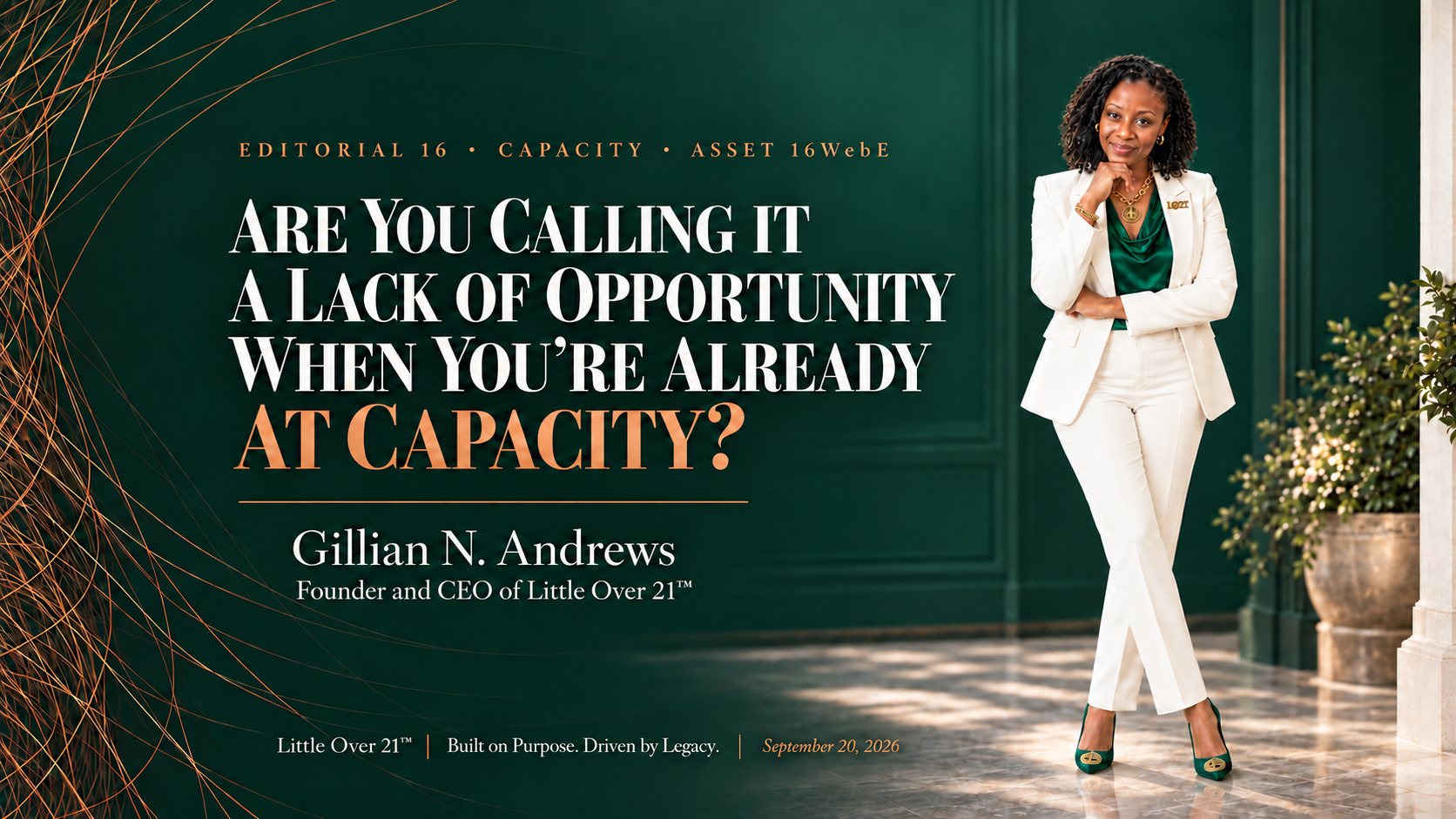
Are You Calling It a Lack of Opportunity When You’re Already at Capacity?
Little Over 21™ Editorial 16 | Capacity | Practical Edition
Published Sunday, September 20, 2026
By Gillian N. Andrews
What if the opportunity you need requires capacity you had to spend just to survive?
The invitation came in on Tuesday. You saw it between two obligations and thought, I need to respond to that. By Wednesday, someone needed a ride, a payment was due, and the work you planned to finish on Monday was still waiting. On Thursday night, you opened the message again. You started a reply, fell asleep with the phone in your hand, and woke up to another day that was already asking for more than you had.
The following week, you watched someone else announce the very thing you had been hoping to do.
You told yourself you missed your opportunity. Maybe you did. But the part that hurts is knowing you wanted it, saw it, and still could not find enough of yourself to reach for it.
We often speak about opportunity as though desire is the only requirement. If you want it badly enough, you will make time. If you are serious, you will find a way. If it matters, you will figure it out. Those lines sound powerful until they land on someone whose days are already divided among work, family, bills, caregiving, and the thousand small tasks that keep a life from falling apart. Tell that person to “make time,” and you may be asking them to produce something they do not have.
Some people have choices they are afraid to make. Others are working every position available because one income does not cover the life they are responsible for. Many of us are somewhere in between: carrying what we must, carrying what we agreed to, and carrying what we have not yet found the courage or the resources to put down. From the outside, all three look like a full schedule. On the inside, they require different answers.
I know what it means to look at a week and see one responsibility pressed against the next. Higher Education space. Elementary School Education space. The office. Little Over 21™. The LO21™ Legacy Foundation. With Love, Val™. Those are commitments with people, purpose, and bills attached to them. I cannot wave away the work that earns an income because I need a new home, a new car, the next cruise. I also cannot pretend that needing the work makes me endlessly available to do it.
That is the part of capacity we rarely say plainly: sometimes we are working so hard to build a different life that we have almost no room left to live the one we are in.
You get up early to work on your dream before the job that pays you begins. You use lunch to answer messages for the second thing. You spend the evening fulfilling a commitment you made because the money mattered, the mission mattered, or someone was counting on you. Then you get home and look at the unfinished work that is supposed to become your future. You know exactly why it matters. You are simply out of hours.
So you borrow them from sleep. Then you borrow from patience. Eventually, you borrow from your attention, your health, and the people who only seem to get the version of you that has nothing left. You promise yourself you will catch up on Sunday. Sunday comes, and all the things that could not fit into the rest of the week are waiting at the door.
When someone asks how you are, you say, “Busy, but good.” Sometimes you are good. Sometimes you are grateful. Sometimes you are proud of what you are managing. You can be all of those things and still be over capacity. Gratitude does not erase exhaustion. Purpose does not make every demand sustainable. Needing the money does not make the cost invisible.
And yet we keep treating the warning signs as personal shortcomings. We miss a deadline and call ourselves undisciplined. We forget to follow up and call ourselves unprofessional. We turn down an invitation and wonder whether we lack ambition. We sit in front of something we have wanted for years and cannot begin it, so we question whether we wanted it enough.
Maybe the question is whether you have any capacity left to give it.
Look at what happens when a genuinely good opportunity appears. It may come with an application to complete, a meeting to attend, materials to prepare, travel to arrange, or a stretch of unpaid time before it produces income. It may ask for your best thinking at the end of a day that has already used it. An opportunity can be real and valuable and still arrive with a cost of entry you cannot currently afford. Missing it hurts. Being told you must not have wanted it badly enough hurts differently.
There are also opportunities we call “good” because we are frightened to admit they cost too much. The extra project brings money, but it takes every weekend. The role brings visibility, but no support. The request comes from someone you love, but it depends on your always being the one who rearranges everything. Each yes makes sense when you examine it alone. Together, those yeses leave you with a life in which nothing has enough room.
That is where we have to tell ourselves a harder truth. Not every demand on our capacity comes from necessity. Sometimes we say yes because we need the income. Sometimes we say yes because we do not want to disappoint someone. Sometimes we keep a role because being needed has become part of who we are. Sometimes the task we call urgent is easier to face than the larger decision we have been avoiding.
We cannot sort those things out by simply looking at a calendar. We have to ask what each commitment is doing in our lives. What pays for a necessity? What protects a relationship or a responsibility we have chosen to honor? What moves us toward the future we say we want? And what stays on the calendar because removing it would require a conversation we do not want to have?
The answers may be uncomfortable. You might discover that you cannot put down a job, but you can stop giving unpaid time to a person who assumes you will always be available. You might find that an opportunity needs a later start date or more support than you have been willing to request. You might have to admit that a commitment once served you well and now takes more than it gives. You might also discover that there is very little you can change immediately. That truth deserves honesty, too. Naming a limit does not magically remove it, but it can stop you from promising yourself to one more thing as though the limit were not there.
Capacity is not merely how many tasks you can force into a day. It is what you can carry while still having enough of yourself to think, decide, recover, and be present. It changes. A responsibility that fit last year may be too much this year. A goal you care about deeply may need a different route. None of that makes the goal less real.
This week, before you add another obligation in the name of getting ahead, take inventory of what is already claiming you. Count the paid work and the unpaid work. Count the planning, travel, care, follow-ups, and recovery that never appear in the neat version of your schedule. Notice which commitments you can change, which ones need support, and which ones you are not yet in a position to leave. Look closely at the small pocket of time you keep calling “free.” Has it ever actually been free?
Then ask yourself a question that may be more useful than “Why haven’t I done more?”
What am I asking myself to accomplish with capacity I no longer have?
I am not asking you to stop wanting more. I am asking you to tell the truth about what it takes to receive it. We have explored desire. We have asked what we need to recognize and what we must relinquish. Now we must look at the life that remains and ask whether it has room for what comes next. If it does not, the answer may involve changing a commitment, asking for help, renegotiating a timeline, or building support we do not yet have. For some of us, it will take more than one difficult conversation and more than one season.
There is no shame in admitting that you need the work and that the work is wearing you down. There is no virtue in calling yourself available when you are already beyond your limit. And there is no reason to wait until something important breaks before you believe what your exhaustion has been telling you.
The opportunity may be out there. You may be capable of doing something extraordinary with it. But capacity asks one more question before you reach for it:
Where, in the life you are living right now, will it go?
Little Over 21™
Where the Question Is Only the Beginning.
Built on Purpose. Driven by Legacy.
LO21™ Alignment Framework™ | Truth • Ownership • Discipline • Legacy • Voice