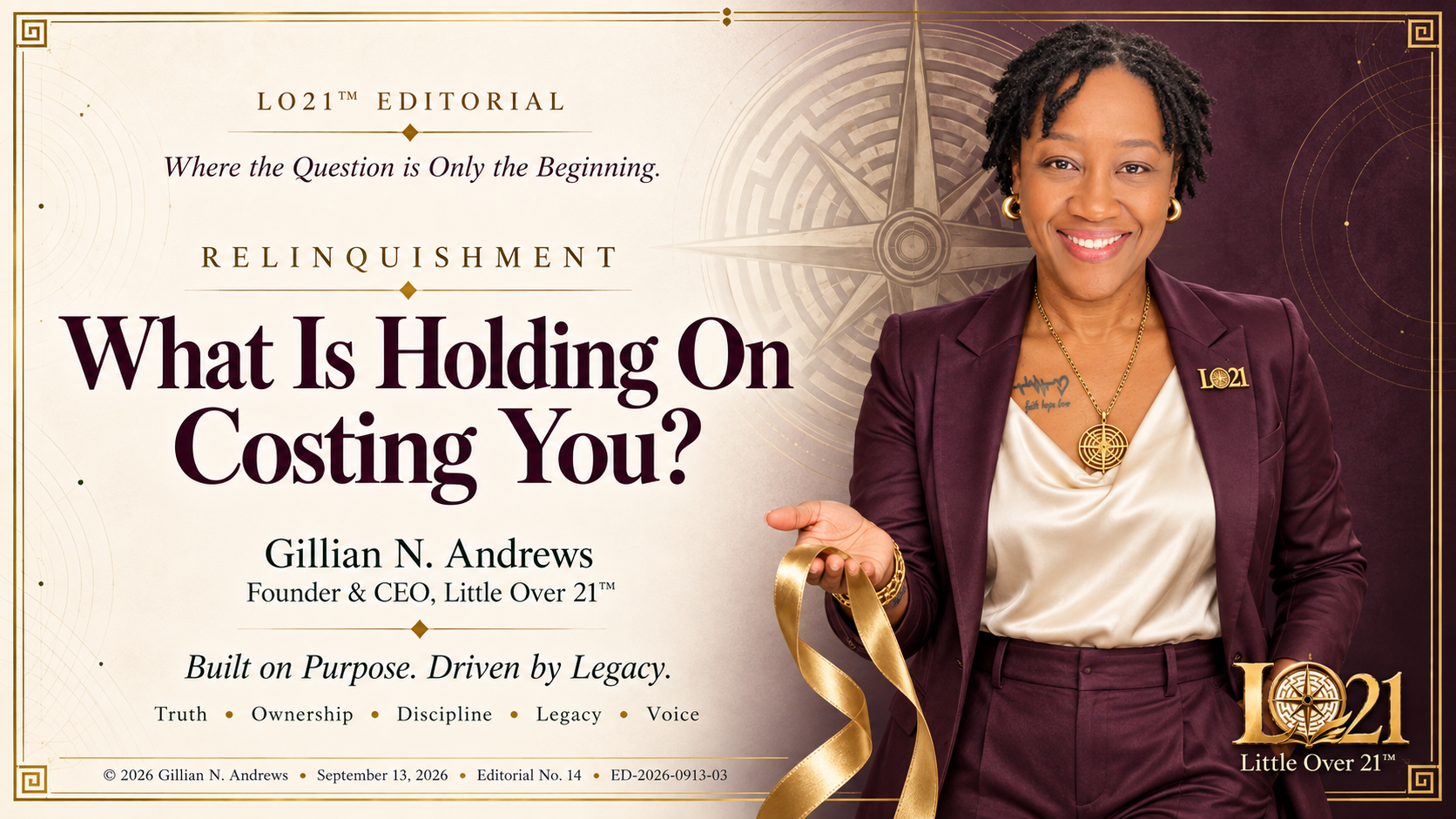
Relinquishment: What Is Holding On Costing You?
LO21™ EDITORIAL
Where the Question is Only the Beginning.
Imagine this: it is Sunday evening, and you are looking at the week ahead. There is the meeting you no longer believe serves a purpose, the commitment you accepted when your life looked different, and the person who assumes you will handle something because you always have. Somewhere between the reminders and the responsibilities is something you actually want to build. You will get to it when things settle down.
Things have been preparing to settle down for quite some time.
You study the calendar as though the problem might be solved by moving a few appointments. Yet the harder question sits beneath the scheduling: how much of this life are you actively choosing, and how much are you continuing because you have not reconsidered an earlier yes?
That is where relinquishment becomes practical.
Recognition brings something into view. Relinquishment asks what we are willing to do with what we now see. It can involve a business decision, a relationship expectation, a family role, or an idea of success that no longer fits the person responsible for pursuing it. Often, the first thing we need to release is the assumption that a commitment must continue in its original form simply because it once made sense.
What are you actually holding?
Before deciding what to release, we need to identify what we are holding. The answer may be less obvious than it appears.
A business owner might be attached to a service that no longer fits the company’s direction. Underneath that attachment may be pride: this was the offering that brought the first clients through the door. Retiring it feels almost disloyal to the beginning. Someone else might be holding on to a role in a relationship because being needed has become part of how they recognize their own value. Another person might be defending a plan that has stopped working because they announced it publicly and cannot bear the thought of explaining a change.
The service, the role, and the plan each carry a meaning beyond their practical function. That meaning deserves attention. Otherwise, we can change the circumstances and recreate the same arrangement somewhere else.
Ask yourself: am I protecting something that remains worthwhile, or am I protecting what keeping it allows me to believe about myself?
There may be elements of both. Honest examination does not require a dramatic verdict. It requires enough precision to know what decision you are actually making.
When perseverance needs a review
Perseverance deserves respect. Businesses, relationships, and meaningful work all encounter seasons when the results lag behind the effort. If we abandoned everything at the first uncomfortable moment, very little would have the opportunity to mature.
Still, perseverance needs somewhere to go.
Consider a business offering that requires extensive preparation, constant exceptions, and a level of personal involvement that leaves little room for other work. Perhaps it remains valuable. Perhaps it needs a different price, a narrower scope, or a better process. Perhaps its purpose has been fulfilled. Continuing it without examining those possibilities turns yesterday’s decision into a standing instruction for tomorrow.
The question is not simply whether the work is difficult. What is the difficulty producing? Is there evidence of progress? Are the conditions improving? Is there a realistic change you can make, and are you willing to make it?
We can respect what an investment taught us without committing indefinitely to the same arrangement. The hours already spent belong to our history. The hours ahead still require a decision.
Leadership adds another layer. Sometimes what needs to be relinquished is personal control over every detail. A founder wants the business to grow but remains the required approval point for every routine decision. A manager wants initiative but corrects every approach that differs from their own. The people around them are invited to contribute, provided their contribution looks remarkably like an imitation.
Delegation becomes rather limited when you hand over the assignment but keep custody of the steering wheel.
Responsible release takes preparation: clear expectations, sufficient information, defined authority, and an agreed way to review results. You can remain accountable while allowing someone else genuine room to work.
What does the relationship need you to release?
Relinquishment in a relationship does not always begin with deciding whether to leave. It may begin with examining an expectation that has been directing the relationship without ever becoming a conversation.
Perhaps you expect someone to recognize every need without being told. Perhaps you are still responding to the person they were years ago, leaving little room to acknowledge who they are now. Perhaps every disagreement becomes a trial in which the goal is to establish who has the better memory, the stronger argument, or the longest record of disappointment.
What happens if you relinquish the need to win that trial long enough to understand what needs repair?
That does not require pretending harm did not happen or accepting promises in place of changed behavior. It requires identifying what would actually help. An apology, a different agreement, more consistent effort, or a boundary may be needed. Those needs become easier to discuss when the conversation has a purpose beyond proving the other person wrong.
There is also an expectation we may need to release about our own influence: the belief that sufficiently careful words will make someone willing to participate. We can communicate clearly, take responsibility for our conduct, and make a reasonable invitation. The other person’s willingness remains theirs.
A relationship may have room to grow when both people can acknowledge the problem and help change the conditions. Where that participation remains absent, we have different information to consider. Discernment includes paying attention to what happens after the conversation.
When being dependable becomes an assignment without an end
Within families, friendships, and workplaces, dependable people can become the default destination for unfinished work.
You know how to organize it. You remember the details. You can be trusted to follow through. Over time, a skill becomes an expectation, and an expectation becomes a role nobody remembers formally assigning.
Some responsibilities are truly yours. Others require a careful handover. Some have accumulated because you repeatedly stepped in before anyone else had to step forward.
Sorting those differences matters. Practical relinquishment might sound like, “I can help with this part, but I cannot manage the entire process.” It might mean asking who will take responsibility next month, teaching someone what they need to know, or allowing a nonurgent problem to remain unresolved long enough for its owner to address it.
The discomfort can be surprisingly personal. If being useful has become a reliable way to feel valued, doing less may raise a question you have avoided: will I still matter when I am no longer making everything easier?
That question deserves care. It also deserves an answer larger than another assignment.
You may grieve the future you imagined
Even when a change is necessary, something meaningful may be lost. A business plan held a picture of independence. A relationship held an imagined future. A familiar role gave your days structure and made your contribution visible.
Relinquishment can involve grieving a possibility you had organized your life around.
That grief should have room. You do not have to dismiss the value of what you wanted to justify choosing differently now. Something can have mattered deeply and still require new terms. A decision can be appropriate and still take time to absorb.
Relief may arrive alongside sadness. You might miss being needed while appreciating the space you have recovered. You might feel proud of a responsible change and embarrassed that it took you so long. None of those feelings, on its own, provides a complete assessment of the decision.
Return to what you know about the circumstances, the available choices, and the life you are trying to build. Let your feelings inform that examination without requiring every feeling to become an instruction.
Make relinquishment a decision you can carry out
Choose one commitment rather than attempting to reorganize your entire life in an afternoon. Describe it plainly. “Everything is too much” expresses a real feeling, but “I am managing a weekly obligation that someone else could share” gives you something specific to examine.
Consider both its contribution and its cost. What does it support? What does it consume in time, attention, money, or availability? What would change if you continued exactly as you are? What would be affected if you stopped?
Then examine the available responses. Keeping the commitment may be reasonable. Revising its terms, sharing responsibility, pausing it, or ending it may also be reasonable. If you lack essential information, the next step may be to investigate before deciding.
Give the decision a practical form. Schedule the conversation. Write the revised scope. Agree on a handover date. Decide what you will stop doing and what you will keep providing. Where other people depend on the arrangement, make the transition clear enough that they can respond.
Finally, consider what the recovered space is for. An open evening can disappear into another obligation before you have experienced it. A freed hour at work can become an invitation to absorb somebody else’s unfinished task. Protecting space may require a second decision after creating it.
Ownership includes reconsidering your yes
Within the LO21™ Alignment Framework, relinquishment belongs primarily under Ownership. We examine what is ours to carry, acknowledge the agreements we continue to reinforce, and take responsibility for changes within our authority. Truth helps us name the circumstances. Discipline supports the follow-through. Legacy asks what our choices are building over time. Voice allows us to communicate those choices clearly.
Ownership also requires recognizing that our options are not always immediate or unlimited. Some changes take resources, preparation, and cooperation. A transition plan can be an act of relinquishment before the final departure or handover occurs.
The point is to bring a continuing commitment back into conscious consideration. An earlier yes deserves review when the conditions, the purpose, or the person carrying it have changed.
You can honor what mattered without making it govern every next choice. You can appreciate what you built and still decide how much of your future it should occupy.
What are you still holding on to and what could you make room for if you stopped giving it so much of your life?
Gillian N. Andrews
Founder & CEO, Little Over 21™
Built on Purpose. Driven by Legacy.
The LO21™ Alignment Framework: Truth • Ownership • Discipline • Legacy • Voice
September 13, 2026 • Editorial No. 14 • Expanded Website Edition • Asset ID: ED-2026-0913-01
© 2026 Gillian N. Andrews. All rights reserved.