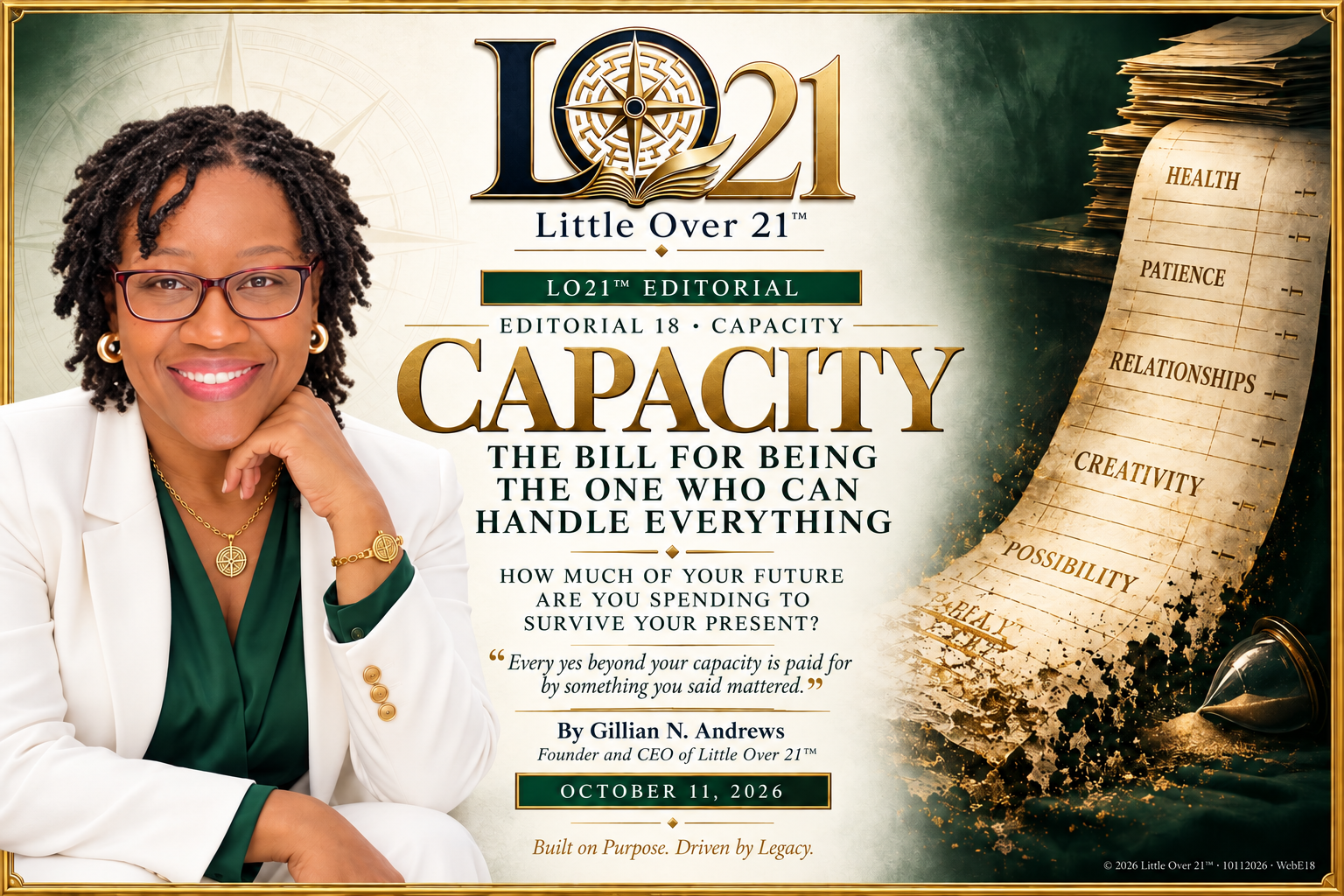
THE BILL FOR BEING THE ONE WHO CAN HANDLE EVERYTHING
Central Question: How much of your future are you spending to survive your present?
Publication Date: Sunday, October 11, 2026
LO21™ Alignment Framework Category: OWNERSHIP
Imagine this.
Everybody calls her because she always figures it out. The missed deadline. The emergency pickup. The bill someone forgot to pay. The project nobody properly planned. The family problem that somehow becomes hers to solve. The work somebody else promised to finish. She does not necessarily volunteer, but she rarely lets anything fall. People have learned that if they hand her the problem, she will eventually return with a solution.
She has become so good at saving the day that nobody asks what each rescue costs her.
Eventually, neither does she.
Her phone rings before she has rested. Her calendar fills before she has considered what she needs. Her money leaves before she can decide what she wanted it to build. Her patience is divided among people who believe they are each asking for only one small thing. She keeps answering, arranging, correcting, covering, remembering, and carrying.
From the outside, she looks capable.
From the inside, she is overdrawn.
Nothing has visibly collapsed, so everyone assumes she is managing. She assumes it too. The deadlines are met. The children arrive where they need to be. The work gets submitted. The calls are returned. The crisis passes. The room applauds the outcome without asking what had to be sacrificed to produce it.
That is how capacity debt survives undetected.
THE PERFORMANCE OF CAPACITY
We often measure capacity by completion. If you finished it, you must have had room for it. If you handled it, perhaps it was not too much. If you arrived, delivered, smiled, answered, and solved the problem, people conclude that you were able to carry it.
Completion proves that something got done. It does not prove that the cost was sustainable.
You can finish the assignment after sacrificing sleep. You can rescue the family while neglecting your own household. You can meet every professional expectation while your health quietly absorbs the pressure. You can remain emotionally available to everyone else while offering the people closest to you whatever remains.
You can survive something that should never become your standard.
Capacity is not the maximum amount of pressure you can withstand before something breaks. Capacity is the amount your life can hold without repeatedly stealing from the parts of you that also deserve to live.
The dependable person often misses this distinction. They are accustomed to measuring strength by endurance. They have learned how to stretch a dollar, a deadline, an hour, a meal, a conversation, and themselves. Their competence creates the appearance of abundance, even when every internal account is running low.
Capacity debt is dangerous precisely because it can look like functioning.
WHEN COMPETENCE BECOMES PERMISSION
Being capable is not consent.
Your ability to solve a problem does not automatically make the problem yours. Your history of finding a way does not give everyone permanent access to your time, energy, attention, money, or emotional labor. Your competence should not become an open invitation for other people to plan poorly, contribute less, or assume you will absorb whatever remains.
Yet that is frequently what happens.
Once you become known as the person who can handle everything, people begin building their expectations around your ability to compensate. They leave gaps because you usually fill them. They arrive unprepared because you usually remember. They make commitments that depend on your labor without consulting your capacity.
The dependable person becomes infrastructure.
People notice immediately when the dependable person stops functioning, but they rarely notice how much functioning has required. Reliability becomes so normal that the sacrifice supporting it disappears from view.
This does not always happen because people are malicious. Sometimes we train others to expect access by repeatedly providing it without renegotiation. Sometimes we say yes before checking what the yes will cost. Sometimes we would rather carry another responsibility than tolerate the discomfort of disappointing someone.
Ownership requires us to tell the truth about both sides. People may benefit from our overextension, but we may also be participating in the pattern that keeps it alive.
EVERY YES HAS A CREDITOR
Every yes beyond your capacity is paid for by something you said mattered.
The payment may come from sleep. It may come from your health, patience, creativity, intimacy, concentration, or ability to experience joy without calculating what still needs to be done. It may come from the business you keep postponing, the book you keep delaying, the relationship that keeps receiving your leftovers, or the future you insist you are working toward.
“One more thing” is never only one more thing.
Every responsibility requires time, thought, movement, preparation, recovery, or emotional presence. When no unclaimed capacity remains, the new responsibility does not enter for free. It displaces something already living there.
The dependable person may not immediately see what was displaced. The cost often appears elsewhere. You become irritated with someone who did not create the original pressure. You lose interest in something you once loved. You stop returning personal calls while continuing to answer professional ones. You cancel the appointment meant to care for you because someone else has an emergency.
The bill does not disappear because you paid it silently.
Your present life may be surviving because your future keeps extending credit. Tomorrow’s energy pays for tonight’s deadline. Next month’s money pays for today’s emergency. Your future relationships pay for the conversations you keep postponing. Your future body pays for the recovery you refuse to schedule now.
The question is not merely whether you can keep going.
The question is what will remain when you arrive.
THE FUTURE SELF WHO INHERITS THE BILL
We speak about the future self as though that person will be stronger, wealthier, calmer, more organized, and better prepared. We assign that future version of ourselves every task we do not have room to complete today.
Later, I will rest.
Later, I will address my health.
Later, I will repair the relationship.
Later, I will write the book.
Later, I will create the plan.
Later, I will finally make room for myself.
The future self becomes the imaginary employee responsible for cleaning up everything the present self refuses to renegotiate.
What happens when the future arrives and discovers that the energy intended to build it has already been spent?
Sacrifice can be meaningful. Temporary seasons of extraordinary effort are sometimes necessary. The problem begins when temporary survival becomes a permanent operating model. A crisis cannot remain the architecture of your life without eventually becoming your life.
Your future should not arrive and discover that everything intended for it has already been consumed.
REST IS NOT ALWAYS REPAYMENT
Rest matters, but a nap cannot repair a life designed to overdraw you.
A weekend away cannot permanently solve expectations that remain unchanged. A quiet evening cannot repair a calendar that automatically gives everyone else first access. One canceled event cannot restore capacity if every responsibility returns untouched on Monday morning.
Repayment requires more than recovery. It requires renegotiation.
Something may need to be delegated. Something may need to be delayed. Something may need to receive less. Something may need to end. Someone may need to become uncomfortable because you are no longer volunteering your future to protect their present.
This is where the conversation becomes difficult. Many dependable people do not fear responsibility. They fear what will happen if they stop absorbing it.
Who will be disappointed? Who will call them selfish? What will fall apart? What truth will become visible about the people, workplaces, relationships, and systems that have been functioning through their unpaid capacity?
The answer may be uncomfortable, but discomfort is not always evidence that you made the wrong decision. Sometimes discomfort is what happens when an unsustainable arrangement loses its most reliable participant.
THE BILL BELONGS TO THE PRESENT
You do not need to punish yourself for surviving. You do need to stop calling every form of survival sustainable.
Begin by noticing what consistently receives the leftovers. What part of your life is always asked to wait? What commitment exists because you chose it, and what commitment remains because everyone assumes you will continue? What have you been calling temporary that has quietly become your permanent structure?
Then ask the harder question:
What has been paying for your reliability?
If the answer is your health, your peace, your closest relationships, your creativity, your financial stability, or the future you claim to want, the present arrangement is not free. You are simply sending the invoice forward.
Ownership does not mean abandoning everyone who depends on you. It means refusing to build a life in which your disappearance is the only thing that would finally reveal how much you were carrying.
You are allowed to make the cost visible before collapse makes it visible for you.
THE CONFRONTATION
Perhaps you are still getting everything done. Perhaps people continue complimenting your strength. Perhaps nothing has fallen apart enough to justify the changes you already know you need to make.
That does not mean the current arrangement is sustainable.
It may only mean you have become exceptionally skilled at hiding the debt.
The goal is not to become less dependable. The goal is to stop making promises with resources that belong to your health, your relationships, your purpose, and your future.
Your future self should inherit more than unfinished recovery.
Your future self should inherit evidence that you were thinking beyond the emergency. Evidence that you protected something. Evidence that you allowed support. Evidence that you stopped mistaking constant availability for love, leadership, loyalty, or strength.
Every yes beyond your capacity is paid for by something you said mattered.
Before you accept one more obligation, rescue one more situation, or promise that you will find a way, ask yourself:
How much of my future am I spending to survive my present?
Built on Purpose. Driven by Legacy.
© 2026 Little Over 21™ · 10112026 · WebE18