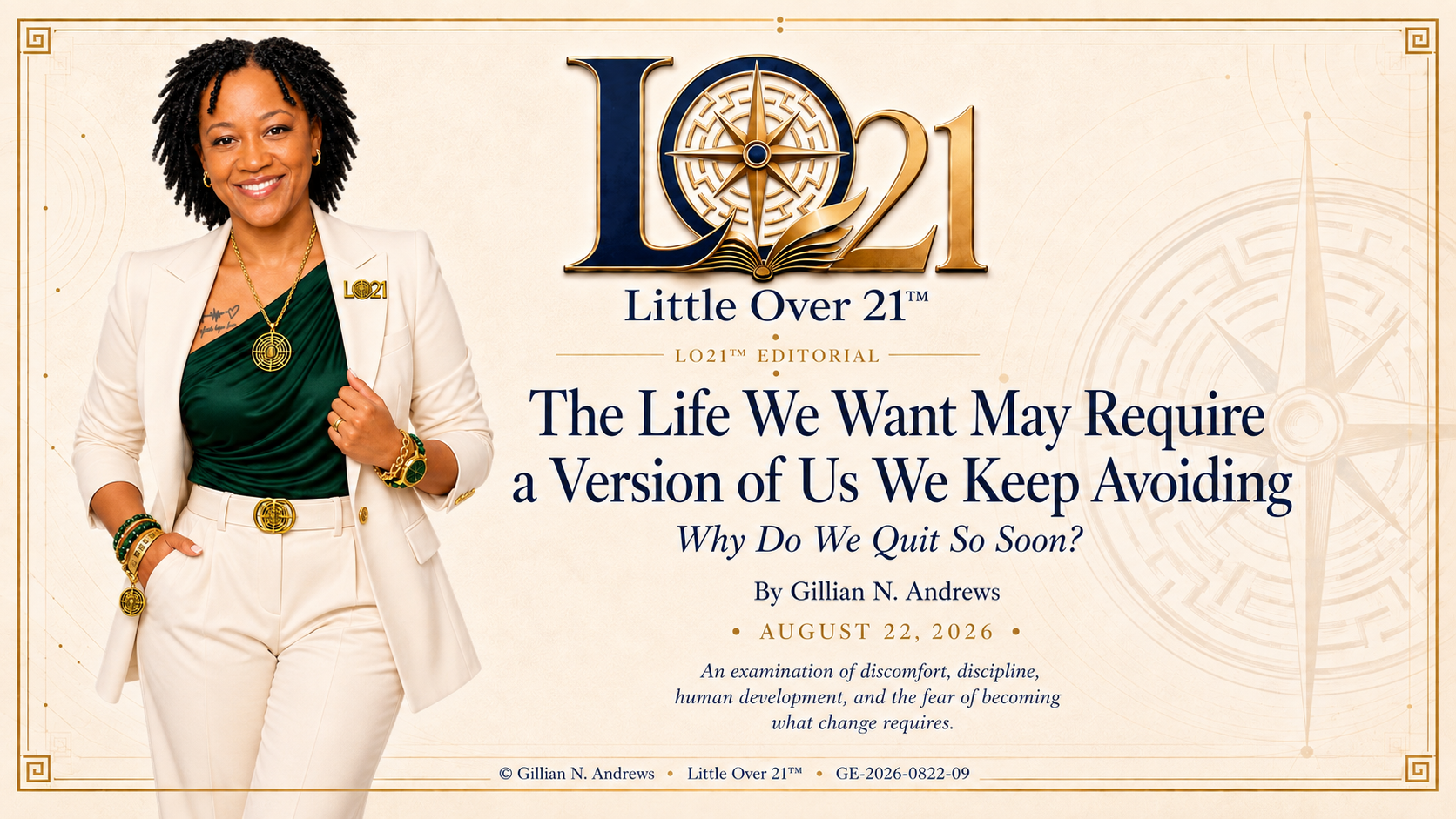
THE LIFE WE WANT MAY REQUIRE A VERSION OF US WE KEEP AVOIDING
Why Do We Quit So Soon?
By Gillian N. Andrews
Where the Question Is Only the Beginning.
Imagine that everything you say you want is actually possible.
Not guaranteed. Not easy. Not arriving neatly wrapped on the date you requested it. Simply possible.
The degree. The career. The business. The healthier relationship. The stronger body. The repaired confidence. The book. The leadership opportunity. The financial stability. The boundary you keep promising yourself you will establish. The life you keep describing when someone asks what you really want.
Now imagine discovering that getting there requires you to become someone you have not yet learned how to be.
That changes the fantasy a little, doesn't it?
Wanting the outcome is one thing. Becoming the person capable of building, receiving, sustaining, or protecting that outcome is something else entirely.
Perhaps that is part of the reason we quit so soon.
The question is bigger than perseverance. It is bigger than motivation. It may even be bigger than discipline.
What if we keep asking life to change while quietly resisting the version of ourselves that change requires?
WE SAY WE WANT THE PARADIGM SHIFT
We talk constantly about change.
Education needs to change. Work needs to change. Leadership needs to change. Relationships need to change. Families need to communicate differently. Organizations need new thinking. Businesses need innovation. People need boundaries. Communities need healing. Individuals need to stop repeating patterns that no longer serve them.
We want transformation everywhere.
Then transformation knocks on our own door.
Suddenly the conversation becomes considerably less theoretical.
Real change may ask us to reconsider something we have believed for years. It may require an uncomfortable conversation, the admission that we contributed to a problem, a new skill, a changed routine, delayed gratification, an apology, patience, repetition, vulnerability, or the humiliation of becoming a beginner again.
That is the part of transformation we do not always advertise.
Everyone wants the paradigm shift until the paradigm being shifted is their own.
We are comfortable demanding that institutions evolve, employers improve, partners communicate, children mature, leaders change, and society do better. The harder work begins when the question turns around.
What has to change in me?
Not what should someone else stop doing. Not what should the organization fix. Not what should my partner finally understand.
What does the future I claim to want require me to learn, release, confront, practice, or become?
That is a much quieter question.
It is also considerably more dangerous to the stories we tell ourselves.
SOMEWHERE, DIFFICULTY BECAME INFORMATION
Difficulty has always communicated something. The problem is that we may have become too quick to decide what it means.
The student struggles and thinks, Maybe I am not smart enough.
The employee is stretched by a new responsibility and thinks, Maybe this job is not right for me.
The entrepreneur experiences months of slow growth and thinks, Maybe the business does not work.
Two people discover that chemistry did not magically provide them with conflict-resolution skills and think, Maybe we chose the wrong person.
Someone starts changing a lifelong habit, slips, and thinks, See? I knew I couldn't do this.
The challenge is real. The interpretation may not be.
Carol Dweck's work on growth mindset has examined this relationship between belief, ability, challenge, and learning. Stanford describes a growth mindset as understanding that intellectual abilities can develop rather than treating them as permanently fixed. Importantly, Dweck's work has also been simplified over the years into something she did not intend: merely praising effort or telling people to try harder. Growth requires feedback, strategy, adjustment, learning, and support, not blind persistence.
That distinction matters here.
The answer to difficulty is not automatically, Keep going.
Sometimes the answer is, Change your strategy.
Sometimes it is, Ask for help.
Sometimes it is, Learn more.
Sometimes it is, Try differently.
Sometimes it is, Stop.
The discipline is not in choosing the same answer every time.
The discipline is in staying with the question long enough to determine which answer is true.
Difficulty is data. It is not automatically a stop sign.
THE PROBLEM WITH A WORLD BUILT TO REMOVE FRICTION
There is another layer to this conversation that deserves our attention.
Human beings have spent centuries making life easier. Much of that progress is extraordinary. Convenience is not the enemy. Technology has expanded access, saved time, connected people, reduced barriers, improved communication, and solved problems previous generations simply had to endure.
Still, convenience changes expectations.
If something takes too long to load, we refresh it. If a video does not capture us immediately, we move on. If dinner requires too much effort, someone can bring it to the door. If we do not like what we are watching, thousands of alternatives are waiting. If we need information, we can access more of it in seconds than previous generations could locate in days.
We have become extraordinarily good at reducing friction around ourselves.
There is just one inconvenient problem.
Many of the things human beings value most still contain friction.
Education does.
Mastery does.
Leadership does.
Parenting does.
Friendship does.
Marriage does.
Entrepreneurship does.
Healing does.
Trust certainly does.
You can improve the tools. You can accelerate access. You can make communication instantaneous. You can shorten distribution, automate processes, and eliminate unnecessary barriers.
You still cannot microwave maturity.
Human development does not offer same-day delivery.
That tension matters. We increasingly live inside systems designed to respond to us immediately while trying to build lives that require patience.
Perhaps we should at least consider what that does to our expectations.
What happens when convenience becomes normal enough that ordinary difficulty begins to feel like dysfunction?
What happens when waiting feels like failure?
What happens when boredom feels like misalignment?
What happens when a relationship requiring work feels defective because so many other things can simply be replaced?
What happens when the first difficult semester becomes evidence that the degree is wrong?
What happens when the business does not become profitable at internet speed?
What happens when healing refuses to follow our preferred timeline?
Maybe the problem is not that humans suddenly became weak.
Maybe we have become accustomed to living in environments where friction is increasingly treated as something that should be engineered away.
Life did not get that memo.
SCHOOL: WHEN STRUGGLE BECOMES IDENTITY
Children reveal this problem early.
A child struggles with multiplication and does not merely say, I don't understand this yet. The conclusion becomes, I'm bad at math.
A paper comes back covered with corrections, and the feedback can feel less like information about the work and more like information about the person.
Adults do the same thing. We simply use better vocabulary.
Research associated with growth mindset has repeatedly examined how beliefs about ability influence responses to challenge. Stanford's teaching resources note that students with more fixed beliefs about intelligence may be more inclined to see setbacks as proof of limited ability, while students with growth-oriented beliefs are more likely to treat challenge as an opportunity to adjust strategy, learn, and persist.
The distinction between I cannot do this and I cannot do this yet is only one word.
Psychologically, it can be an enormous distance.
Education should challenge us. That does not mean every educational environment is healthy, every instructor effective, or every academic path appropriate. It does mean that confusion is not necessarily proof of incapacity.
Sometimes confusion is what learning feels like before understanding arrives.
Being challenged is not the same thing as being incapable.
WORK: GROWTH OFTEN MAKES COMPETENT PEOPLE FEEL INCOMPETENT
Professional growth presents its own trap.
People often become excellent at one level of work and then earn an opportunity to move into another. Suddenly the expertise that created confidence in the old role does not automatically translate into the new one.
The strong individual contributor becomes a manager and discovers that performing the work and leading people through the work are different skills.
The small business owner begins hiring employees and realizes that doing everything personally and building systems through other people require different thinking.
The experienced leader enters a larger organization and discovers complexity that did not exist in the previous environment.
Growth can make highly competent people feel temporarily incompetent.
That is not always evidence that the promotion was a mistake.
Sometimes you have simply reached a place where your previous competence can no longer carry you.
The career question, then, becomes more sophisticated than Am I comfortable here?
Is the environment unhealthy, or am I being stretched?
Have I reached a ceiling, or a learning curve?
Am I undervalued, or impatient?
Is this role inconsistent with my values, or demanding skills I have not yet developed?
Those questions cannot be answered by motivational slogans. They require truth.
They also require the ability to remain uncomfortable long enough to collect enough evidence to know the difference.
RELATIONSHIPS: WHEN PEACE BECOMES THE ABSENCE OF DISCOMFORT
Relationships make this conversation especially complicated because leaving can absolutely be an act of self-preservation.
Abuse should not be endured in the name of perseverance. Chronic disrespect is not personal development. Manipulation is not an opportunity to practice patience. Nobody needs an editorial telling them to tolerate what is destroying them.
The distinction matters.
Healthy relationships, however, still involve two histories, two communication patterns, two sets of expectations, two nervous systems, two families, two ideas about money, intimacy, responsibility, affection, conflict, boundaries, and what it means to feel loved.
Eventually, difference arrives.
The question becomes what we believe difference means.
Have we begun defining peace as never having to experience relational discomfort?
Have we confused boundaries with never having a conversation we would rather avoid?
Have we become so focused on protecting our peace that we occasionally protect ourselves from the very conversations required to build peace?
Sometimes the healthiest thing two people can do is leave.
Sometimes the healthiest thing two people can do is finally stay in the conversation.
Compatibility does not eliminate the need for communication.
THE EMOTIONAL LENS: MAYBE WE ARE QUITTING THE FEELING
This may be the most important part of the conversation.
Research by Kaitlin Woolley and Ayelet Fishbach examined whether people could be motivated by treating discomfort itself as a signal of personal growth. Across five experiments involving more than 2,100 adults and several types of growth-oriented activities, participants encouraged to seek discomfort became more engaged and reported greater goal achievement than those receiving standard instructions.
The research does not suggest that all discomfort is good. That would be irresponsible.
It suggests something more interesting.
In situations where personal growth naturally involves discomfort, the meaning assigned to discomfort can change how people respond to it.
That raises a question I cannot ignore.
What if sometimes we are not quitting the thing? What if we are quitting the feeling?
The business creates uncertainty.
School creates intellectual insecurity.
Leadership creates exposure.
A difficult conversation creates vulnerability.
Exercise creates physical discomfort.
Writing creates the possibility of judgment.
Changing creates grief for the identity we are leaving behind.
Trying creates the possibility of public failure.
Sometimes exit solves the immediate emotional problem beautifully.
If I stop trying, I cannot fail at it again.
If I never submit the manuscript, nobody can reject it.
If I leave before the difficult conversation, I do not have to hear what the other person might say.
If I avoid the promotion, I never have to discover whether I can actually lead at that level.
If I abandon the goal, I no longer have to experience the gap between where I am and where I hoped I would be.
Escape can feel remarkably similar to relief.
The problem is that relief and alignment are not always the same thing.
GRIT, BUT NOT THE FAIRY TALE VERSION
Angela Duckworth and her colleagues introduced grit into psychological research as perseverance and passion for long-term goals. Their original research found associations between grit and several achievement outcomes and argued that difficult accomplishments require more than talent; sustained effort matters.
That idea resonated for an obvious reason.
Most meaningful achievements do require sustained work.
Later scholarship has also complicated the grit conversation. Researchers have questioned how much grit independently predicts achievement and whether perseverance without meaningful passion simply becomes grinding. That critique is useful because perseverance should never become an excuse for staying attached to goals, systems, or circumstances that no longer make sense.
We do not need another philosophy telling people to suffer simply because they started something.
Persistence without reflection is not discipline.
Neither is quitting without reflection.
Wisdom sits somewhere between the two.
There are moments when grit means staying.
There are moments when discipline means pivoting.
There are moments when ownership means admitting that the plan is failing.
There are moments when truth requires acknowledging that the plan is fine and we simply do not enjoy how much it requires from us.
That last possibility deserves more attention than we usually give it.
THE LO21™ QUESTION IS NOT “HOW BADLY DO YOU WANT IT?”
Within the LO21™ Alignment Framework, Discipline does not live alone. It sits beside Truth, Ownership, Legacy, and Voice.
That matters.
Truth asks us to identify what is actually happening.
Ownership asks us to examine what belongs to us.
Discipline asks what we are willing to practice consistently once desire loses its novelty.
Legacy asks us to consider what our choices are building beyond today's comfort.
Voice asks whether we are able to name what we know, need, believe, fear, and choose.
This is why I am less interested in asking someone, How badly do you want it?
People can want things intensely and still lack the systems, skills, patience, habits, support, information, boundaries, or courage necessary to build them.
The better question may be:
What does the life you want require from the life you are currently living?
Something may have to change.
A routine.
A belief.
A relationship with time.
A spending pattern.
A communication habit.
An expectation.
A fear.
A comfort.
An identity.
That is where discipline becomes more than consistency.
It becomes architecture.
You are not merely forcing yourself to continue.
You are building a person, a system, a relationship, a career, a business, or a life capable of supporting what comes next.
THE PARADIGM SHIFT WE ARE AFRAID TO MAKE
Perhaps our real fear is not change.
Maybe it is responsibility.
A paradigm shift removes excuses along with limitations.
If I decide I can learn, I may have to study differently.
If I acknowledge that my communication contributes to the problem, I may have to change how I speak.
If I admit the business needs a new strategy, I may have to abandon an idea I love.
If I acknowledge that my goal is still possible, I may have to stop using impossibility as protection from trying.
If I admit that I am capable of more, eventually I will have to decide whether I am willing to require more of myself.
That can be frightening.
There is strange safety in believing the door is locked.
A locked door removes responsibility.
An unlocked door asks whether you are going to walk through it.
Possibility can be terrifying when it eliminates the excuse of impossibility.
Maybe that is why paradigm shifts are so difficult.
They do not simply change what we know.
They change what we can no longer pretend not to know.
SO, WHY DO WE QUIT SO SOON?
There will never be one answer.
Sometimes we quit because something genuinely needs to end.
Sometimes we are exhausted.
Sometimes we lack resources.
Sometimes the environment is wrong.
Sometimes the evidence has changed.
Sometimes another responsibility matters more.
Sometimes continuing would cost too much.
Sometimes quitting is the most disciplined decision available.
Still, sometimes we quit because we expected growth to feel different.
We expected progress to feel more obvious.
We expected confidence before competence.
We expected relationships without uncomfortable conversations.
We expected careers without learning curves.
We expected businesses without slow seasons.
We expected healing without grief.
We expected transformation without disruption.
Perhaps we expected the new life without fully understanding that the old version of us could not simply move into it unchanged.
That may be the paradigm shift.
The life we want may not require us to suffer endlessly for it.
It may require us to stop assuming that discomfort automatically means we are going the wrong way.
Quit what deserves to be quit. Leave what threatens your safety, dignity, values, health, or future. Change strategies when the evidence says the strategy is wrong. Pivot when wisdom demands it. Release goals that no longer belong to you.
Just do not hand difficulty the authority to make every decision.
Before you walk away, remain with the question long enough to answer it truthfully:
Is this wrong for me, or is this simply requiring more of me?
Then ask the question beneath the question.
If the life you keep saying you want requires you to think differently, communicate differently, practice differently, wait differently, fail differently, recover differently, and eventually become different, are you actually willing to experience what becoming feels like?
Maybe the challenge was never simply learning how not to quit.
Maybe the deeper challenge is learning not to mistake discomfort for a command to leave.
The world around us will continue becoming faster.
Human development probably will not.
Perhaps that is why the next paradigm shift will not be technological at all.
It will be learning how to remain present long enough to become.
Gillian N. Andrews
Founder & CEO, Little Over 21™
Built on Purpose. Driven by Legacy.
Works Cited
Duckworth, Angela L., et al. “Grit: Perseverance and Passion for Long-Term Goals.” Journal of Personality and Social Psychology, vol. 92, no. 6, 2007, pp. 1087–1101. https://doi.org/10.1037/0022-3514.92.6.1087.
Dweck, Carol S. Mindset: The New Psychology of Success. Random House, 2006.
“Growth Mindset and Enhanced Learning.” Stanford Teaching Commons, Stanford University, teachingcommons.stanford.edu/teaching-guides/foundations-course-design/learning-activities/growth-mindset-and-enhanced-learning. Accessed 22 Aug. 2026.
Jachimowicz, Jon M., et al. “Why Grit Requires Perseverance and Passion to Positively Predict Performance.” Proceedings of the National Academy of Sciences, vol. 115, no. 40, 2018, pp. 9980–9985. https://doi.org/10.1073/pnas.1803561115.
Woolley, Kaitlin, and Ayelet Fishbach. “Motivating Personal Growth by Seeking Discomfort.” Psychological Science, vol. 33, no. 4, 2022, pp. 510–523. https://doi.org/10.1177/09567976211044685.
© 2026 Gillian N. Andrews. All Rights Reserved.
Little Over 21™