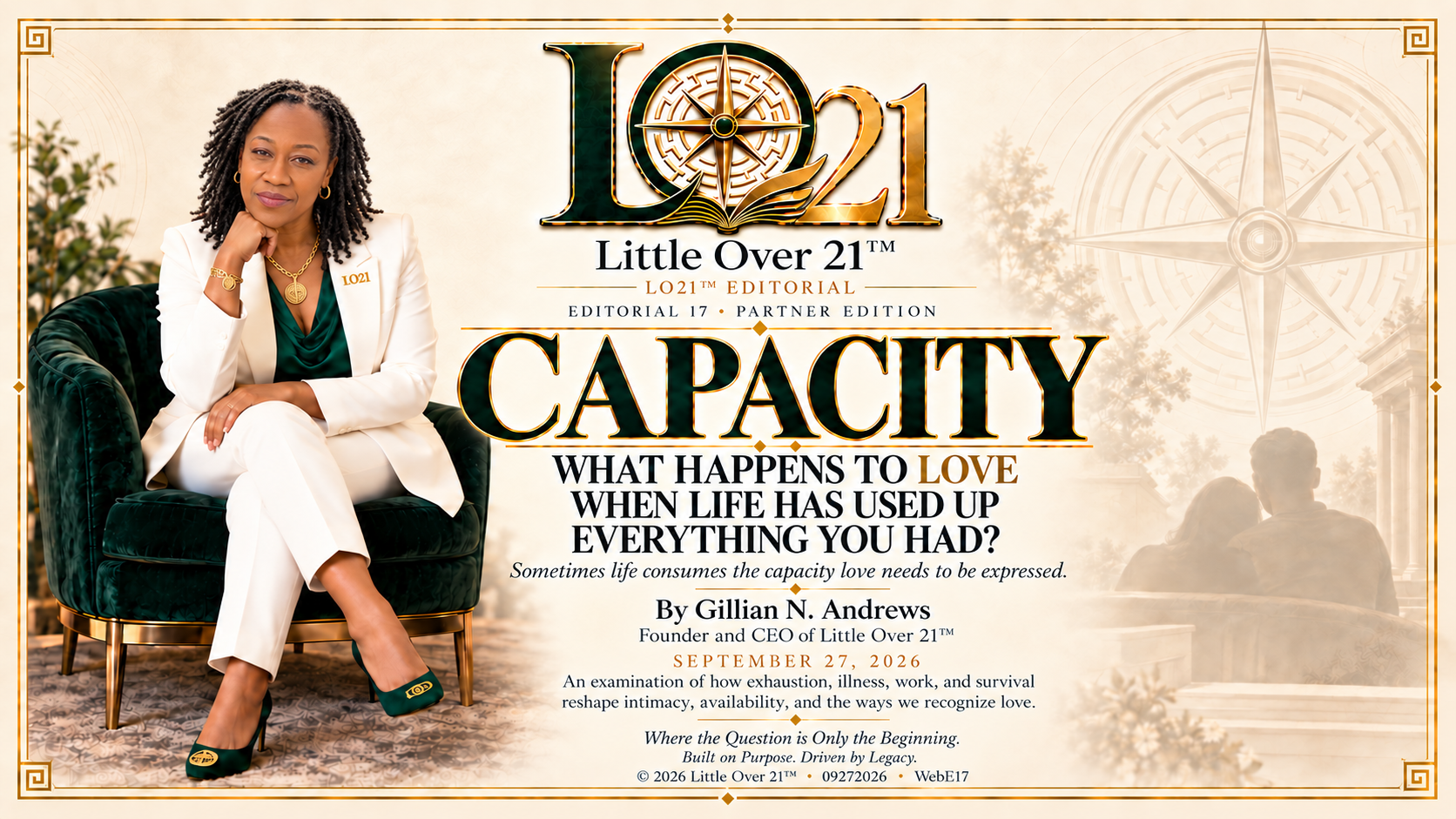
What Happens to Love When Life Has Used Up Everything You Had?
Little Over 21™ Editorial 17 | Capacity | Partner Edition
By Gillian N. Andrews, Founder and CEO of Little Over 21™
Published September 27, 2026
Imagine this.
Two people are lying in the same bed. One reaches across the space between them, hoping for affection, conversation, sex, anything that says, We are still here.
The other person does not move.
They are not angry. They are not punishing anyone. They are not secretly planning an exit. They are trying to locate enough energy to respond without turning tenderness into one more obligation they have failed to meet.
One person experiences the silence as rejection. The other experiences the reaching hand as another request from a world that has already taken everything.
Neither person is imagining the pain. Neither person is necessarily wrong. But if they do not name what is happening, both will begin writing explanations for a silence they do not understand.
You don’t want me anymore.
You have time for everyone except me.
I cannot give you one more thing.
Why does loving me feel like work to you?
The relationship may still contain love. What it may no longer contain is enough capacity for that love to be expressed in ways the other person can recognize.
We usually discuss capacity as though it belongs to calendars, careers, and commitments. We ask whether someone has room for another project, another client, another responsibility, or another opportunity. We rarely ask what happens when work, caregiving, survival, illness, financial pressure, and emotional labor consume the capacity that intimacy needs.
But capacity follows us home.
It enters the bedroom. It sits at the dinner table. It changes the tone of an ordinary question. It determines whether touch feels comforting or demanding. It can turn a simple conversation into one more task someone does not know how to complete.
Exhaustion does not always look like sleep. Sometimes it looks like irritation. Sometimes it looks like silence, canceled plans, unanswered messages, forgotten affection, or turning away from someone you still love. It can look like having enough energy to complete the responsibilities that cannot be avoided but none left for the relationship you assumed would understand.
That is where the misunderstanding begins.
The person watching from the outside sees you working, answering calls, helping other people, and meeting responsibilities. They reasonably wonder why you cannot find anything for them. What they may not see is that responsibility is operating on necessity. Intimacy requires presence, vulnerability, attention, and choice. A person can force their body through an obligation long after they have lost the emotional capacity to be tender.
That does not make the person beside them hurt any less.
Sometimes the relationship is not suffering from a lack of love. It is suffering because life has consumed the capacity love needs in order to be expressed.
There is a difference between loving someone and being emotionally available to them. Love may remain when patience is gone. Desire may still exist when the body is too tired to respond. Commitment may be present even when someone cannot tolerate one more conversation. The feelings may be real while the ability to demonstrate them has temporarily collapsed.
That distinction matters, but it cannot become a permanent excuse.
Capacity may explain why someone has withdrawn. It does not erase what that withdrawal is doing to the person beside them.
The depleted partner is not the only person in the relationship. The other person may be lonely. They may have spent weeks reaching carefully, trying not to ask for too much, while quietly wondering whether they are still wanted. They may be ashamed of needing reassurance from someone who is already overwhelmed. They may start reducing their own needs to avoid becoming another burden.
Eventually, they may stop reaching.
Not because they stopped loving, but because repeatedly extending a hand into silence changes a person, too.
Both people can be hurting at the same time. One can be depleted while the other is deprived. One can need space while the other needs reassurance. One can experience touch as pressure while the other experiences its absence as abandonment. Relationships become dangerous when we decide that only one of those experiences is legitimate.
A person at capacity should not be required to manufacture romance, conversation, or sexual availability to prove that love remains. A partner should not be expected to survive indefinitely on feelings that are never communicated or demonstrated.
The work is not choosing whose pain matters more. The work is learning how to tell the truth before silence decides what the relationship means.
Sometimes the first truth is physical.
The body has a way of ending negotiations we believed we could continue. We postpone rest, rearrange sleep, suppress discomfort, and promise ourselves that we will recover after the next deadline. Then illness, exhaustion, pain, or complete shutdown interrupts the schedule.
This does not mean every illness was caused by overwork. It means becoming unwell can reveal how little room we left for recovery.
A person with capacity can become sick and rest. A person already beyond capacity becomes sick and immediately begins calculating which responsibilities they can disappoint without losing something essential.
They are not asking, What does my body need?
They are asking, What can fall apart without taking everything else with it?
And while they are calculating, the relationship is watching.
Sometimes we recognize our limits. Sometimes the body removes our right to negotiate with them. By the time the body finally says no, the relationship may have been hearing no for months, in shortened conversations, postponed affection, absent touch, unfinished apologies, and promises to reconnect when life settles down.
Life does not always settle down on its own.
That is why “We’re just busy” can become one of the most dangerous ordinary sentences in a relationship. It sounds temporary. It asks both people to wait. It offers no plan for what will change or when the relationship will stop surviving on leftovers.
Weeks become months. The exceptional season becomes the household’s permanent climate. Two people become excellent at managing the business of life while slowly losing the ability to experience one another inside it.
They coordinate transportation. Pay bills. Raise children. Solve problems. Exchange information. Sleep beside one another. From the outside, the relationship appears functional.
Inside, neither person feels held.
This is not always the dramatic collapse we associate with relationship trouble. There may be no affair, explosive argument, or slammed door. Sometimes intimacy disappears quietly because every practical demand seemed more urgent than the connection holding the people together.
What looked ordinary was slowly becoming consequential.
The absence of sex may not have begun as rejection. It may have begun with fatigue.
The silence may not have begun as punishment. It may have begun because someone did not have the strength to explain another complicated feeling.
The distance may not have begun because love ended. It may have begun because both people assumed they would reconnect later.
Later needs an address. Otherwise, it becomes the place where relationships send everything they do not want to confront today.
This is where both partners have questions to answer.
If you are depleted, have you told the person beside you what is happening, or have you expected them to interpret your silence generously? Have you explained what you can offer, what you cannot offer, what you need, and whether this season has any possibility of changing? Have you allowed “I’m at capacity” to become the end of the conversation when it should have been the beginning of a different one?
If you are the person reaching, are you asking for intimacy or demanding proof? Can your partner tell you they have nothing left without being required to perform affection to manage your fear? Are you helping create the conditions in which closeness can return, or are you adding pressure and calling it love?
You cannot demand softness while contributing to someone’s exhaustion.
You also cannot repeatedly give everyone else the best of you, hand your partner whatever remains, and insist that they should be grateful because you came home.
That truth may hurt, but relationships cannot live honestly without it.
Capacity in a relationship is not simply about whether we have enough time for date night. It is whether we have enough emotional room to notice one another. It is whether we can hear a need without immediately experiencing it as criticism. It is whether touch can occur without an unspoken expectation attached to it. It is whether one person can say, “I have nothing tonight,” while still finding a way to communicate, “But I have not stopped choosing us.”
Sometimes intimacy at capacity looks different.
It may be sitting beside one another without talking. It may be asking, “Do you need help, company, or space?” It may be holding someone without expecting that touch to become sexual. It may be taking something off their plate before asking them to open their heart. It may be saying, “I cannot give you the evening we imagined, but I can give you twenty honest minutes.”
That is not settling for less. It is designing connection around the truth of the moment instead of demanding that two overwhelmed people imitate a version of love they cannot currently sustain.
But temporary adaptations need honest evaluation. There is a difference between a difficult season and a permanently unavailable partner. There is a difference between someone who lacks capacity and someone who consistently refuses responsibility for the impact of their absence. Compassion should not require one person to abandon their own needs indefinitely.
Ask what is consuming the relationship’s capacity. Is it work? Caregiving? Illness? Financial pressure? Unresolved resentment? An unequal household? Has one person become responsible for remembering, planning, anticipating, and emotionally carrying everything? Is the exhaustion temporary, or has depletion become the only version of this relationship either person knows?
Then ask the question few people want to answer:
Who consistently receives the best of you, and who has been expected to love whatever is left?
The answer is not always to leave a job, cancel every responsibility, schedule an expensive getaway, or manufacture a romantic evening. The answer may begin with a redistribution of labor, an honest timeline, a medical appointment, outside support, clearer boundaries, or the admission that the current arrangement is unsustainable.
Sometimes the most intimate thing a partner can say is not, “I miss you.”
It is, “I see what this life is costing you, and I do not want to keep benefiting from your exhaustion.”
Sometimes the most loving response is not another demand for connection.
It is, “What can I carry so you do not have to disappear in order to survive?”
And sometimes the depleted person must say, “I still love you, but love cannot keep asking you to live on what remains after everything else has finished with me.”
Love may remain when energy, desire, patience, and availability disappear. But love cannot remain invisible forever and expect the relationship to survive on faith. At some point, depletion must be named, support must be negotiated, and intimacy must be rebuilt in a form both people can actually sustain.
Before you decide that the love is gone, ask what has been consuming the person who once knew how to reach for you.
Then ask whether the two of you are willing to create enough room to reach for each other again.
This conversation continues in The Human Experience Field Guide™: Capacity, created to be read on your own, worked through together, and brought into your life.
Little Over 21™
Where the Question is Only the Beginning.
Built on Purpose. Driven by Legacy.
© 2026 Little Over 21™ · 09272026 · WebE17