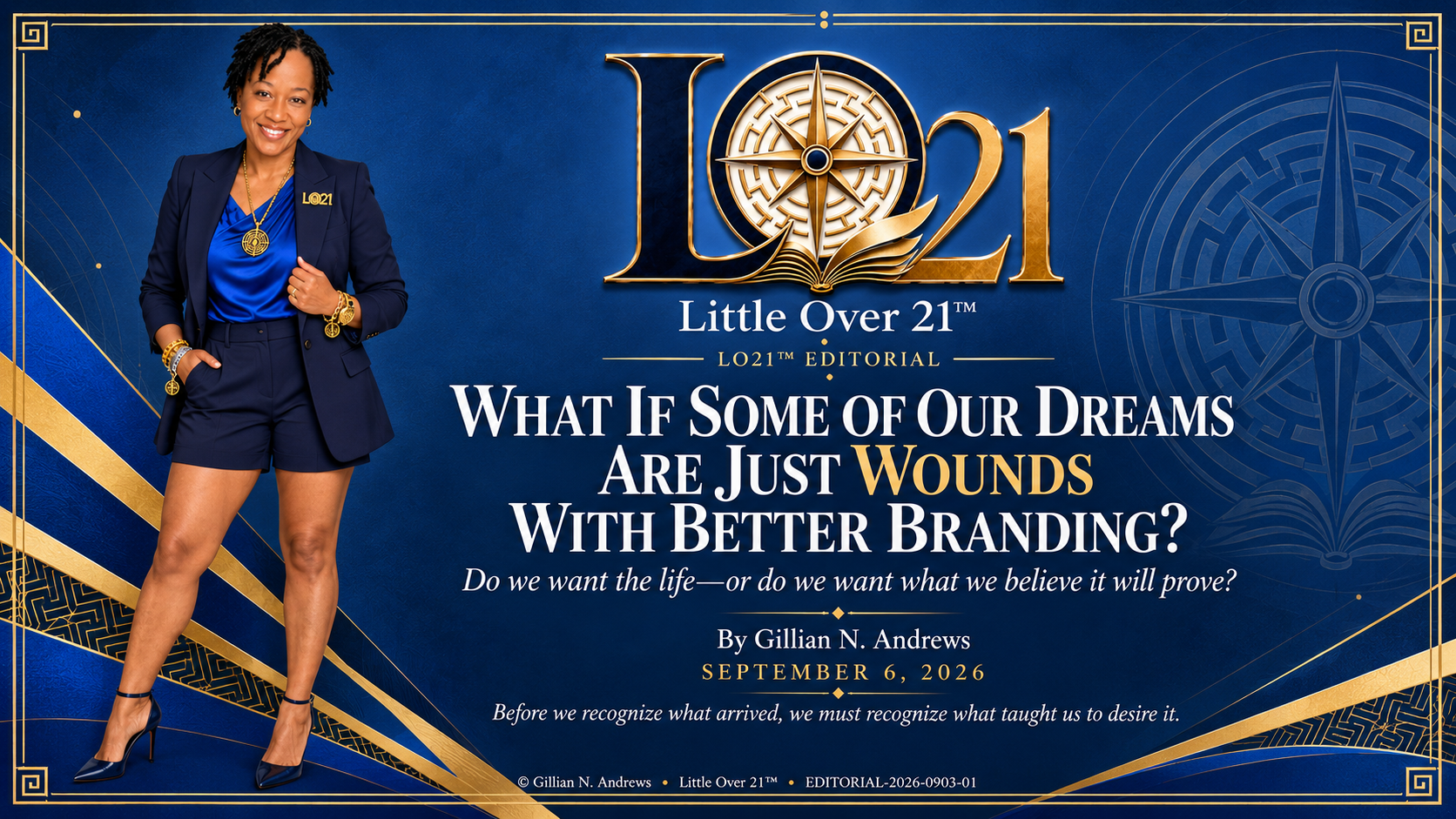
What If Some of Our Dreams Are Just Wounds With Better Branding?
Do we want the life, or do we want what we believe it will prove?
By Gillian N. Andrews
Founder & CEO, Little Over 21™
Primary LO21™ Alignment Framework Pillar: Ownership
Supporting Pillars: Truth and Voice
Published September 7, 2026
Where the Question is Only the Beginning.
EDITORIAL NOTE
This editorial was developed during Desire Week, when Little Over 21™ asked, “What do we really want?” Its publication arrives as we enter Recognition Week and confront the next question: “Can we recognize what we asked for when it does not arrive in a familiar package?”
Perhaps recognition must begin even earlier. Before we ask whether we recognize what arrived, we may need to examine who, or what, taught us to desire it.
********************
Some of us did not heal. We simply became productive enough that nobody thought to ask.
We built the business. Earned the degree. Changed our bodies. Became indispensable. Learned how to enter rooms that once intimidated us and make our names sound expensive. We called it ambition, discipline, resilience, and reinvention. Perhaps it was all of those things.
Perhaps some of it was pain with a project plan.
That possibility is uncomfortable because ambition is one of the few places where a wound can receive applause. When pain makes us successful, society rarely questions it. We admire the hours, the sacrifice, the refusal to quit. We celebrate the person who turned rejection into results and humiliation into a personal brand. We praise the transformation without examining the contract underneath it.
Who must regret losing us? Who must finally admit that we were valuable? Who needs to see our name, our body, our partner, our platform, our money, or our success before the achievement feels complete?
If someone from our past must witness the future before it feels worthwhile, that person may still hold more authority than we want to admit.
The dream may be real.
The motive may still be wounded.
When the Wound Becomes the Architect
Pain can move us. It can pull us from places where comfort failed to disturb us. It can sharpen our instincts, expose our endurance, and force us to imagine a life beyond the one we inherited. People have created extraordinary things from terrible beginnings. That truth does not need to be softened.
There is a difference, however, between building from what happened to us and continuing to build for what happened to us. One may become growth. The other keeps the injury on the payroll.
Pain can start the engine. It should not be allowed to choose every destination.
Research on post-traumatic growth recognizes that people can experience meaningful psychological change through the struggle with adversity. It does not say suffering automatically creates wisdom. It does not say visible achievement proves that healing occurred. Growth and unresolved distress can occupy the same body, the same life, and even the same success story (Jayawickreme et al.).
That is the part our achievement culture prefers not to discuss. We recognize outcomes more easily than origins. Someone becomes wealthy, so we assume they feel secure. Someone becomes desired, so we assume they feel worthy. Someone becomes independent, so we assume they feel free. Someone becomes visible, so we assume they finally feel seen.
Money can change circumstances without changing the belief that safety may disappear at any moment. Attention can fill a room without touching loneliness. Independence can protect us from disappointment while also protecting us from intimacy. Achievement can prove competence without ever answering the private question beneath the performance: Would I still believe I mattered if I stopped producing?
Some of us are not building a future. We are constructing evidence for a trial that ended years ago.
The jury left. The relationship ended. The parent may never understand. The former friend may never apologize. The people who underestimated us may not be watching. Some may be watching and still refuse to give us the response we built the whole damn thing to receive.
So we produce more evidence.
Another achievement. Another title. Another transformation. Another photograph proving that we are happy, wanted, powerful, healed, and completely unbothered.
Wounds do not always know when they have won.
The Lie Inside “Success Is the Best Revenge”
“Success is the best revenge” is one of those phrases that sounds empowering until we examine who remains in charge.
If our success is revenge, the person who hurt us is still helping to choose the goal. They remain present in the hours we work, the image we construct, the partner we select, the body we pursue, and the audience we require. We may have removed them from our lives while preserving them as the invisible customer for everything we build.
That is not freedom. That is unpaid emotional labor with excellent branding.
Psychologists Jennifer Crocker and Connie Wolfe use the term “contingencies of self-worth” to describe the areas in which people stake their value on meeting certain standards or securing particular outcomes. When worth depends on achievement, appearance, approval, competition, or financial success, a goal stops being merely something we want. It becomes evidence that we deserve respect, safety, belonging, or love (Crocker and Wolfe).
This changes what winning can give us. Success may provide relief, but relief is not the same as freedom. Relief expires the moment our worth encounters another threat.
Research led by Lora Park examined financially contingent self-worth, the tendency to base self-esteem on financial success. The study connected that contingency with greater financial comparison, financial hassles, stress, anxiety, and less autonomy. Wanting money was not the problem. Making money responsible for determining human value was the problem (Park et al.).
Two people can pursue the same income and be building entirely different lives. One may want choice, stability, generosity, and legacy. The other may never need to feel powerless, dismissible, or poor again. Both may become wealthy. Only one may be able to recognize when there is enough.
The same distinction appears in research on life aspirations. Studies differentiating intrinsic goals such as growth, health, meaningful relationships, and contribution from extrinsic goals centered on image, status, money, and recognition have repeatedly found that the two do not nourish well-being in the same way. Achieving an impressive outcome does not guarantee that the person achieving it will feel internally fulfilled (Kasser and Ryan; Niemiec et al.).
None of this makes wealth, beauty, recognition, or ambition immoral. It makes motive consequential.
A trophy cannot perform emotional surgery.
When What We Want Stops Centering Us
This problem does not remain at work. It follows us into relationships, intimacy, sex, and the private places where desire becomes harder to disguise as virtue.
During a recent Little Over 21™ LIVE conversation, a gentleman said he wanted a “freak.” He was not asking for mild adventure. He wanted someone willing to do freaky things.
The declaration sounded clear until the desire required a definition.
“Freaky” is a wonderfully convenient word. It allows us to sound specific while revealing almost nothing. One person’s freak is another person’s Tuesday. The conversation introduced a possibility that did not originate inside his fantasy: perhaps another person’s definition included a vibrating butt plug.
His response changed the conversation.
The point was never the object. The point was what happened when his declared desire developed desires of its own.
Did he want a sexually liberated partner, or a partner liberated only within the borders of his comfort? Did he want exploration, or someone willing to perform activities he had already approved? Did he want mutual freedom, or did he want his fantasy returned to him wearing another person’s body?
That is not only a bedroom question.
We say we want a strong partner until their strength disagrees with us. We want an independent partner until their independence does not organize itself around our needs. We want honesty until the truth is about us. We want intimacy until another person’s interior world refuses to follow the choreography of our expectations.
Sometimes we do not want the full reality of what we named. We want the identity associated with being the kind of person who can say we have it.
This is why our Sultry Saturday conversations begin with connection to ourselves before connection with a partner. Desire without self-intimacy easily becomes performance. If we have not confronted what we want, why we want it, what it means to us, and what we are prepared to encounter, we may hand someone a role we have not read carefully ourselves.
The bedroom is not separate from the human experience. It is one of the places where control, validation, permission, power, surrender, safety, and fear may lose their polite disguises.
Awareness Is Not Alignment
Bridge the Gap is often understood as a conversation about generational differences. That is part of it. It is not all of it.
At Little Over 21™, bridging the gap also describes the movement from awareness to alignment. Awareness is recognizing what we say we want. Alignment requires understanding why we want it, what it demands, whether our behavior supports it, and whether the desire still belongs to the person we are becoming. Everything between recognition and aligned action is the gap.
Some of us have been decorating the gap instead of crossing it.
We have learned the language of healing without changing our relationships. We create vision boards without investigating who supplied the vision. We announce boundaries we do not enforce. We say we want peace while repeatedly selecting situations that allow us to feel needed, powerful, distracted, or familiar. We say we want love while choosing people who keep us auditioning for it.
Awareness can name the pattern. Alignment interrupts it.
That distinction matters because self-awareness can become another hiding place. We can explain exactly why we overwork and still refuse to rest. We can trace our fear of abandonment to its earliest address and continue choosing people who confirm it. We can admit that public success matters because private rejection made us feel small, then keep feeding our lives to an audience that cannot make us whole.
Awareness without changed behavior can become sophisticated avoidance.
The LO21™ Alignment Framework moves through Truth, Ownership, Discipline, Legacy, and Voice. Truth identifies what is present. Ownership ends the fantasy that recognition alone creates change. Discipline protects the new decision when the old pattern feels more familiar. Legacy asks what our choices will leave behind. Voice allows us to name what we genuinely want after performance, punishment, and proving are removed.
Ownership is the pressure point here. We may not be responsible for the wound, but we are responsible for reviewing the authority it still holds.
That review is not a betrayal of who we were. The younger version of us may have needed the dream. The dream may have given us somewhere to run when remaining still felt unbearable. It may have kept us alive, focused, sober, educated, employed, hopeful, or moving.
Gratitude does not require permanent obedience.
Too Grown for This™ is not only about outgrowing people, habits, places, and foolishness. Sometimes we must outgrow the emotional assignment attached to a dream. A dream can rescue an earlier version of us and still become a prison for the person we are becoming.
Remove the Audience
Now comes the ruthless part.
Consider the dream without its audience.
Remove the former partner who needs to see what they lost. Remove the parent whose approval has remained just beyond reach. Remove the relatives who treated our potential like a joke. Remove the friend who underestimated us. Remove the strangers whose attention has become measurable proof that we matter.
Would we still want the business if nobody were impressed by the title? Would we still want the body if it made nobody regret rejecting us? Would we still want the relationship if the photographs received no attention? Would we still want visibility if visibility could not avenge invisibility? Would we still want independence if we believed it were safe to need someone?
If the answer is yes, the examination did not destroy the dream. It returned the dream to its rightful owner.
If the answer is no, that does not make us fraudulent. It makes us honest enough to reconsider a destination chosen by a version of us who was trying to survive.
The existing Little Over 21™ body of work repeatedly returns to permission, self-intimacy, voice, and becoming recognizable to ourselves. That work matters here. Permission is not always permission to begin. Sometimes it is permission to stop pursuing what no longer reflects us. Sometimes it is permission to want something less impressive and more honest. Sometimes it is permission to admit that the dream succeeded at keeping us moving but failed at bringing us home (Andrews).
Releasing a wounded motive does not automatically require releasing the dream. We may keep the company and change the emotional contract. Keep the financial goal and separate income from worth. Keep the ambition and dismiss the imaginary jury. Keep the desire and make room for another person’s humanity. Keep the excellence and stop using exhaustion as proof of seriousness.
The dream does not have to die.
The wound cannot remain its unquestioned architect.
What Do We Really Want?
Not what sounds impressive. Not what photographs well. Not what makes the people who hurt us look foolish. Not what keeps us too busy to feel. Not what permits us to call fear independence, control safety, perfection discipline, or applause love.
What do we want when nobody is available to regret underestimating us?
What do we want when our worth is no longer on trial?
What do we want when the desire is finally permitted to tell the truth about its origin?
Perhaps some of our dreams were born from wounds. That does not make them unworthy. It makes them worthy of examination. We owe ourselves more than blind pursuit. We owe ourselves enough intimacy to know what we are building, who is leading the construction, and what we expect the finished structure to repair.
The most courageous thing we do may not be achieving the dream. It may be admitting what we once needed the dream to prove.
So here is the question we cannot answer with a résumé, relationship status, bank balance, body, title, platform, or round of applause:
If the people who hurt us never witnessed our success, never regretted what they did, and never admitted they were wrong, would we still want the same dream?
The answer may not end the dream.
It may be the first time the dream truly belongs to us.
Works Cited
Andrews, Gillian N. Dare to Be Different: Permission. Little Over 21™ Press & Publishing, 2026.
Crocker, Jennifer, and Connie T. Wolfe. “Contingencies of Self-Worth.” Psychological Review, vol. 108, no. 3, 2001, pp. 593–623. https://doi.org/10.1037/0033-295X.108.3.593.
Jayawickreme, Eranda, et al. “Post-Traumatic Growth as Positive Personality Change: Challenges, Opportunities, and Recommendations.” Journal of Personality, vol. 89, no. 1, 2021, pp. 145–165. https://doi.org/10.1111/jopy.12591.
Kasser, Tim, and Richard M. Ryan. “Further Examining the American Dream: Differential Correlates of Intrinsic and Extrinsic Goals.” Personality and Social Psychology Bulletin, vol. 22, no. 3, 1996, pp. 280–287. https://doi.org/10.1177/0146167296223006.
Niemiec, Christopher P., Richard M. Ryan, and Edward L. Deci. “The Path Taken: Consequences of Attaining Intrinsic and Extrinsic Aspirations in Post-College Life.” Journal of Research in Personality, vol. 43, no. 3, 2009, pp. 291–306. https://doi.org/10.1016/j.jrp.2008.09.001.
Park, Lora E., Deborah E. Ward, and Kristin Naragon-Gainey. “It’s All About the Money (For Some): Consequences of Financially Contingent Self-Worth.” Personality and Social Psychology Bulletin, vol. 43, no. 5, 2017, pp. 601–622. https://doi.org/10.1177/0146167216689080.
Editorial 12 | The Expanded LO21 Editorial Edition
Primary LO21™ Alignment Framework Pillar: Ownership
Supporting Pillars: Truth and Voice
Creation/Archive Date: September 3, 2026
Publication Date: September 6, 2026
Asset ID: EDITORIAL-2026-0903-01
© 2026 Little Over 21™ | Gillian N. Andrews. All rights reserved.
LittleOver21.com | @littleover21
Where the Question is Only the Beginning.