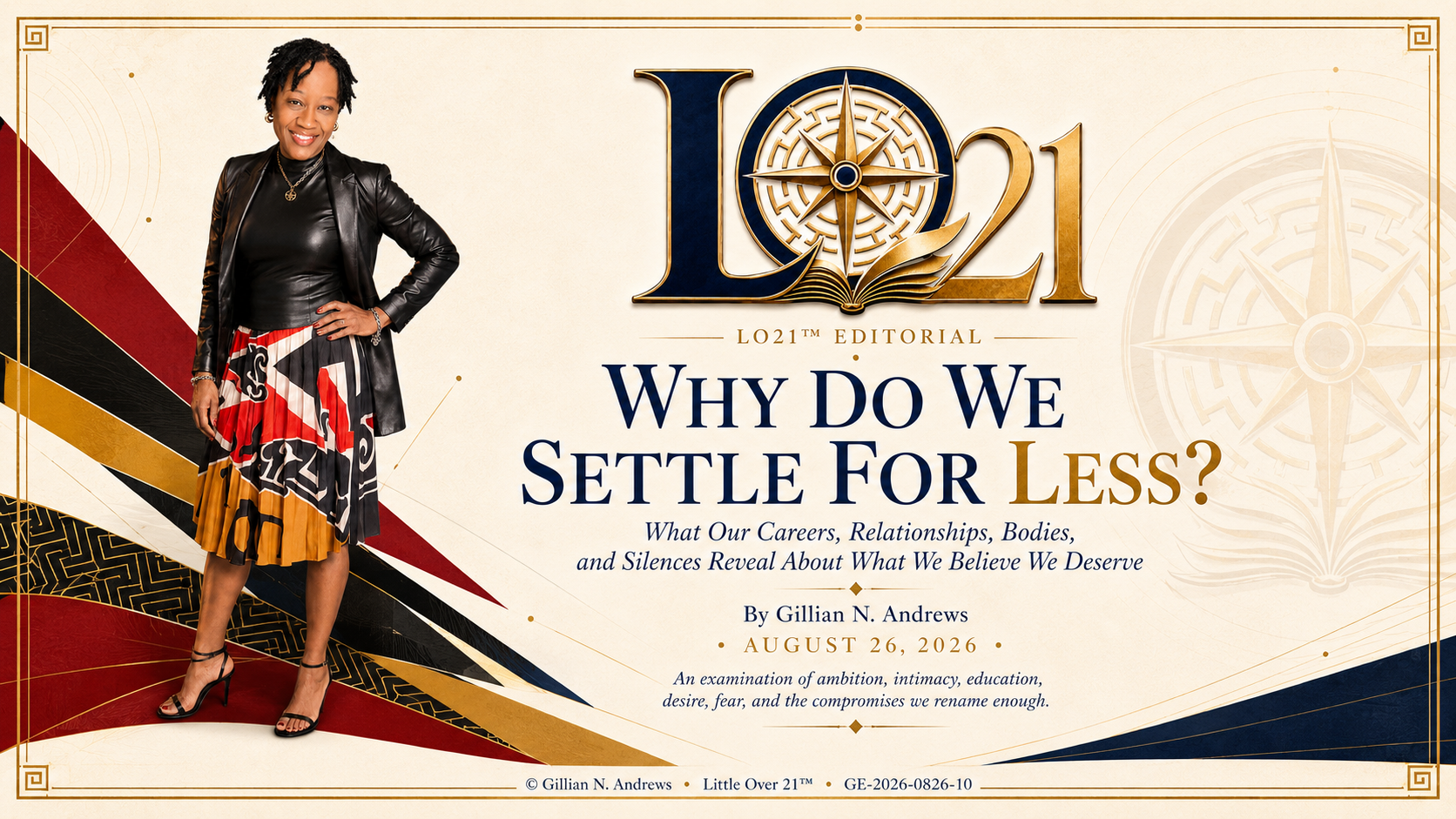
WHY DO WE SETTLE FOR LESS? The Uncomfortable Truth About the Lives, Love, Work -- and Pleasure -- We Keep Accepting
Gillian N. Andrews
Where the Question is Only the Beginning.
How many people are genuinely satisfied with their lives and how many have simply become skilled at surviving their disappointment?
We say we want more. More money. More opportunity. More intimacy. More honesty. More pleasure. More peace. More recognition. More room to become who we know we could be. Yet, when more requires movement, risk, rejection, discomfort, discipline, or a difficult conversation, “less” suddenly starts looking reasonable.
We call it patience. We call it loyalty. We call it being realistic. We call it gratitude. We call it maturity.
Sometimes, it is just fear wearing respectable clothing.
Here is the uncomfortable truth: we do not always settle because we do not know our worth. Sometimes we settle because fully honoring our worth would force us to change our lives.
It would force us to stop asking whether we deserve more and start examining whether we are prepared to make room for it.
That is a very different question.
Less Is Not Always Something Done to Us
Settling is often discussed as though it is something other people make us do. The employer refuses to recognize our value. The partner will not meet our needs. The family will not respect our boundaries. The friend will not reciprocate. The opportunity never arrives.
Those realities exist. People can be dismissed, exploited, manipulated, overlooked, underestimated, and deliberately kept small. Systems can create real barriers. Power is not distributed equally, and every person does not have the same access to money, safety, mobility, education, support, or opportunity.
Still, there is another side of the conversation.
Sometimes less is not merely what someone offers us. It is what we continue accepting after we have recognized that the offer is inadequate.
That does not mean every person can immediately leave, resign, relocate, divorce, enroll, confront, or begin again. It means we must become honest about the difference between what we cannot change today and what we are afraid to change at all.
There is a difference between being trapped and being uncomfortable.
There is a difference between having no choice and refusing to examine the choices that remain.
When Stability Becomes a Hiding Place
Career settling rarely begins with a dramatic decision to abandon our potential. It happens slowly. We take a position because we need the income. We learn the work, prove ourselves, become dependable, and gradually absorb responsibilities far beyond the original job description.
We train the new employee. We fix the mistakes. We cover the vacancies. We rescue the project. We remain available after hours. We become the person everyone calls when something goes wrong.
Our competence becomes convenient for everyone except us.
We are told that we are essential, but the salary does not reflect it. We are praised for our loyalty, but the promotion keeps moving. We are “too valuable” in our current position to advance, which is often corporate language for: You make our dysfunction easier to manage.
Eventually, we stop asking why our labor is not being recognized and start telling ourselves that we should be grateful to have a job.
Gratitude matters. So does rent.
Still, stability and stagnation are not the same thing. A dependable paycheck can support your life, but it can also become the explanation you use for never building another option. Sometimes we remain underpaid because the familiar disrespect feels safer than having to prove ourselves somewhere new.
The job may be exploiting our reliability, but fear may also be exploiting our imagination.
The uncomfortable question is not simply, “Am I being undervalued?”
The deeper question is, “What am I doing with the information?”
The Seduction of Untested Potential
Education exposes another version of settling. People postpone the degree, certification, training program, application, examination, or new skill for years. They say they are waiting for the right time, more money, fewer obligations, greater confidence, or a clearer sign.
Some delays are necessary. Life is expensive. Caregiving is demanding. Access is uneven. Exhaustion is real.
Other delays protect a fantasy.
As long as we never begin, we can continue believing that we would have succeeded. Our potential remains perfect because it has never been tested by deadlines, criticism, sacrifice, comparison, revision, or failure.
Potential is seductive that way. It allows us to feel powerful without requiring proof.
Beginning changes the arrangement. Once we begin, we may discover that we are not naturally excellent at everything. We may need help. We may have to study longer, ask questions, revise our work, manage our time, and become a beginner in front of people who appear more prepared.
Many adults would rather remain privately capable than become publicly inexperienced.
So we settle for the identity of someone who could do more while avoiding the vulnerability of becoming someone who actually does.
When Love Is Present, But Intimacy Is Missing
Relationships complicate settling because love can be real even when fulfillment is not.
A relationship does not need to be abusive, explosive, or publicly disastrous to become emotionally insufficient. Sometimes nobody is cheating. Nobody is screaming. The bills are paid. The photographs look good. The anniversary is acknowledged. The routine remains intact.
Nothing is technically broken.
Nothing is alive either.
Two people can care about one another and still stop being curious about each other. They can share a home, responsibilities, children, memories, and a bed while slowly becoming strangers with excellent logistical coordination.
This kind of loneliness is difficult to explain. When people ask what is wrong, there is no obvious villain and no dramatic event to describe. There is simply an expanding distance between being accompanied and being known.
Many people stay because history feels like evidence that the future must continue. They calculate the years already invested and treat them as a reason to invest more, even when the relationship has stopped producing honesty, intimacy, safety, or growth.
Love deserves effort. Relationships require patience. Every difficult season is not a signal to leave.
Still, commitment should not require one person to disappear so the relationship can survive.
The question is not merely whether love exists. The question is what that love permits, protects, produces, and asks each person to sacrifice.
A Body Can Be Touched Without Being Heard
Sex is one of the clearest places where people accept less while pretending they are satisfied.
How many people have learned to fake pleasure before they ever learned to name what they wanted?
How many protect another person’s ego while abandoning their own body? How many have mastered the performance of enjoyment because honesty might create tension, embarrassment, rejection, or questions they are not prepared to answer?
Some people have never been asked what feels good to them. Some have been asked but did not know how to respond. Others answered honestly and discovered that their desires mattered only when they were convenient.
A body can be touched without being heard.
A person can be sexually active and profoundly untouched.
Sex can be frequent and still lack intimacy. It can be physically competent and emotionally vacant. It can produce an orgasm without producing closeness. It can look passionate while functioning as reassurance, obligation, negotiation, avoidance, performance, or proof that the relationship is still alive.
Being desired is not the same as being known.
Physical access is not the same as intimacy.
Chemistry is not compatibility.
Attention is not care.
Some people accept less pleasure, tenderness, patience, curiosity, communication, and emotional safety because they were taught that expressing desire makes them demanding. They fear being called difficult, selfish, excessive, inexperienced, too experienced, too loud, too quiet, too complicated, or simply too much.
So they become agreeable.
They ask for less. Expect less. Reveal less. Feel less.
Eventually, they may receive exactly what they trained everyone around them to believe was enough.
That truth is not an invitation to blame people for the ways they learned to survive. It is an invitation to notice when survival strategies have outlived the conditions that created them.
Silence does not always mean satisfaction. Silence can become participation in preserving what no longer satisfies us.
The Relationships We Keep Carrying Alone
Settling also appears in friendships that survive through history rather than reciprocity.
We initiate the calls. We remember the birthdays. We check in after the appointment. We send encouragement before the interview. We hold the secrets, offer the rides, attend the events, celebrate the victories, absorb the disappointments, and respond when the emergency arrives.
When we need care, the room suddenly empties.
Still, we hesitate to call the relationship one-sided because we have known the person for years. We treat longevity as proof of quality, even when the connection has become a record of who we used to be rather than support for who we are becoming.
History is meaningful. It is not a lifetime contract.
Some relationships deserve repair. Others deserve an honest reclassification. Every person we love does not have to retain the same access to us forever.
Peace for Whom?
Family settling often hides beneath the language of keeping the peace.
We excuse the insulting comment. We avoid the necessary boundary. We attend the gathering already braced for disrespect. We laugh at the joke that was not funny. We remain quiet so nobody becomes upset.
Nobody except us.
The peace being protected frequently belongs to the person creating the disruption. Everyone else is expected to absorb the impact, lower their expectations, and call their silence maturity.
Peace that depends on one person swallowing repeated harm is not peace. It is managed discomfort.
Boundaries do not guarantee that people will treat us well. They clarify what access remains available when they do not.
Gratitude Should Not Require Self-Erasure
Gratitude is valuable, but it can become dangerous when it is used to discourage growth.
“Be grateful you have a job.”
“Be grateful somebody wants you.”
“Be grateful you were invited.”
“Be grateful your situation is not worse.”
“Be grateful for what you have.”
All of those statements can be true and still be incomplete.
Gratitude can steady us. It can keep ambition from becoming endless dissatisfaction. It can remind us that progress, relationships, opportunities, and ordinary moments deserve acknowledgment.
Yet gratitude should never require self-erasure.
You can appreciate the job and admit it has become too small for your ability. You can love someone and recognize that the relationship no longer honors either of you. You can be thankful for what an opportunity taught you without turning it into a life sentence. You can value what once worked without pretending it still does.
Wanting more does not automatically mean you are ungrateful. Sometimes it means you are finally paying attention.
Less Has Benefits
Settling has benefits. That is why people do it.
Less is familiar. Less lowers the immediate risk of rejection. Less delays conflict. Less allows us to remain close to people who might resist our growth. Less protects us from discovering whether we can actually become the person we keep describing.
Less also preserves our excuses.
If we never apply, we can blame the lack of opportunity. If we never ask, we can blame the silence. If we never communicate our needs, we can blame the other person for not knowing. If we never create a boundary, we can blame people for continuing to cross a line we have not clearly defended. If we never attempt the work, our potential remains untouched by evidence.
Sometimes we are waiting for our circumstances to change.
Other times, our circumstances are waiting for us to stop negotiating against ourselves.
More Has a Price
We speak about “more” as if it is a reward sitting on the other side of desire. More is not free.
More may require discipline. More may require education. More may require hearing no. More may require saving money, rebuilding credit, submitting applications, changing routines, ending relationships, asking difficult questions, admitting what we want, or beginning again without applause.
More may require disappointing people who benefited from our silence.
More may require leaving what is familiar before anything better is guaranteed.
More may require becoming visible.
Perhaps that is what frightens us most.
Visibility removes the shelter of private potential. Once we say what we want, we may be expected to pursue it. Once we name the standard, we must decide what happens when the standard is repeatedly violated. Once we admit that we are dissatisfied, we can no longer pretend we do not understand why our lives feel so small.
What if we are not afraid that more is unavailable?
What if we are afraid that it is available and reaching for it would eliminate every excuse we have used to remain where we are?
Ownership Without Self-Blame
This conversation sits primarily within the Ownership pillar of the LO21™ Alignment Framework, but Ownership should never be confused with blaming ourselves for everything that has happened to us.
Ownership asks us to identify what belongs to us now.
We may not be responsible for the wound, the discrimination, the betrayal, the lack of support, the economic barrier, the relationship we were conditioned to tolerate, or the fear we learned early in life.
We are responsible for becoming honest about what those experiences are still governing.
Truth identifies what we have normalized the least. Voice names what we need, desire, believe, and will no longer disguise. Discipline builds the habits and options that make change possible. Ownership asks what part of the current arrangement we continue renewing through our choices, silence, fear, and repeated agreements.
Legacy asks the final question: What are we teaching other people to accept by watching us?
Settling is not only personal. It can become inherited.
Children watch adults remain silent. Employees watch leaders reward overwork. Families watch disrespect get renamed tradition. Partners watch desire disappear beneath obligation. Communities learn which dreams are celebrated and which ones are quietly discouraged.
We model standards even when we never announce them.
The Question Is No Longer Whether You Deserve More
Of course you deserve a life that does not require your disappearance.
The harder questions are these:
What would more require from you?
What would you have to say clearly?
What would you have to stop pretending not to know?
Who might become uncomfortable if you stopped accepting less?
What relationship, position, identity, habit, or version of yourself would you have to release?
Where are you waiting to be chosen instead of choosing?
Where have you mistaken endurance for loyalty?
Where have you confused familiarity with safety?
Where are you performing satisfaction in your career, your relationships, your education, your body, or your life because honesty would demand movement?
What if the life disappointing you is also the life you keep protecting from change?
Perhaps the most dangerous form of settling is not accepting less once. It is repeatedly accepting less until we forget that we ever wanted more.
So ask yourself the question without rehearsing a respectable answer:
Where have I accepted less, not because it was all I deserved, but because asking for more might require me to leave, speak, risk, learn, disappoint someone, or finally become the person I keep claiming I am ready to be?
What am I still calling “enough” simply because I am afraid to discover what more would demand of me?
The answer may be uncomfortable.
It may also be the first honest step toward more.
More Begins Where Settling Ends.
More Begins Where Settling Ends.
Gillian N. Andrews
Founder & CEO, Little Over 21™
Built on Purpose. Driven by Legacy.
© 2026 Gillian N. Andrews. All Rights Reserved.
Little Over 21™